Low-Carb Burgers: The UK Supermarket Guide
Which pre-packaged burger patties in UK supermarkets are genuinely low-carb? A data-driven guide covering Tesco, Sainsbury's, Asda, Morrisons, Aldi, Lidl, M&S and Waitrose — with hidden carb warnings, bun alternatives, sauce picks and the smash burger technique.
Published Updated
A burger patty is naturally near-zero carbohydrate. The bun, the sauce, and — less obviously — the patty itself can destroy that. Here’s exactly what to buy and what to avoid across every major UK supermarket.
The hidden carb problem with pre-packaged burgers
Pure beef is a zero-carbohydrate food. So why do many supermarket burger patties show 3g, 5g, or even 8g of carbohydrates on the label?
The answer is commercial manufacturing. Forming millions of uniform patties that survive factory production, chilled distribution, and home cooking without falling apart requires binders. Historically, UK burgers used rusk — a dried wheat biscuit — for this purpose. As consumers became wary of wheat, manufacturers switched to “gluten-free” alternatives: tapioca starch, rice flour, maize starch, and potato starch. These are highly refined, rapidly digestible carbohydrates. A gluten-free label means nothing for low-carb purposes — these ingredients are often worse than the wheat they replaced.
The second source of hidden carbs is flavour additions in the premium tier. Caramelised onion chutneys, demerara sugar, fire-roasted onion blends, brown sugar, dried apple, and bone marrow stocks sweetened with tomato paste are all found in products marketed as “gourmet.” The Morrisons Caramelised Onion Beef Burgers contain 7.3g of carbohydrate per 100g — over 12g in a single 170g patty — before the bun is considered.
Carbohydrate profiles by formulation type:
- Pure beef patties (95–100% meat) — typically under 1.5g/100g
- Budget formed patties (with binders) — typically 3–7g/100g
- Seasoned, flavoured or premium gourmet patties — typically 4–9g/100g, read every label
Per-supermarket breakdown
Marks and Spencer
M&S produces the cleanest burger patties in the UK mainstream market.
| Product | Supermarket | Pack | Carbs/100g | Fat/100g | Protein/100g | Low-Carb? | Price |
|---|---|---|---|---|---|---|---|
| Only 3 Ingredients British Beef Burgers | M&S | 400g (4) | 0.3g | 22.0g | 16.4g | Yes | Check |
| Our Best Ever Beef Burgers | M&S | 340g (2) | 1.7g | 21.4g | 16.5g | Yes | Check |
The Only 3 Ingredients line — beef, salt, pepper — sets the benchmark. Their Our Best Ever burgers add bone marrow to the mince, elevating the fat content and mouthfeel to restaurant standard.
Waitrose
| Product | Supermarket | Pack | Carbs/100g | Fat/100g | Protein/100g | Low-Carb? | Price |
|---|---|---|---|---|---|---|---|
| Essential British Beef Burgers | Waitrose | 454g (4) | 1.1g | 12.0g | 22.0g | Yes | Check |
| No.1 Wagyu Beef Burgers | Waitrose | 340g (2) | 2.9g | 14.4g | 22.8g | Yes | Check |
| 8 British Beef Burgers | Waitrose | 454g (8) | 4.9g | 16.9g | 22.3g | Borderline | Check |
Waitrose Essential British Beef Burgers are a model of mid-range simplicity — 1.1g/100g with a clean ingredient profile. The No.1 Wagyu requires tapioca starch to prevent the heavily marbled fat from collapsing the patty during cooking.
Morrisons
| Product | Supermarket | Pack | Carbs/100g | Fat/100g | Protein/100g | Low-Carb? | Price |
|---|---|---|---|---|---|---|---|
| The Best Steak Burgers | Morrisons | 340g (2) | 0.4g | 12.8g | 23.7g | Yes | Check |
| The Best Beef Quarter Pounders | Morrisons | 454g (4) | 0.9g | 18.0g | 24.1g | Yes | Check |
| The Best Scotch Beef Quarter Pounders (Frozen) | Morrisons | 454g (4) | 4.5g | 15.0g | 18.5g | Borderline | Check |
| The Best Caramelised Onion Beef Burgers | Morrisons | 340g (2) | 7.3g | 17.1g | 19.7g | Avoid | Check |
Morrisons The Best range delivers outstanding value. The Steak Burgers at 0.4g/100g are among the best mid-range options in the UK. Avoid the Caramelised Onion variant entirely.
Sainsbury’s
| Product | Supermarket | Pack | Carbs/100g | Fat/100g | Protein/100g | Low-Carb? | Price |
|---|---|---|---|---|---|---|---|
| TTD Ultimate Steak Burger | Sainsbury’s | 340g (2) | under 0.5g | 15.5g | 22.1g | Yes | Check |
| TTD Dry Aged Aberdeen Angus Beef Burgers | Sainsbury’s | 340g (2) | 1.2g | 17.5g | 20.5g | Yes | Check |
| TTD Signature Beef Rib and Brisket Burgers | Sainsbury’s | 340g (2) | 0.5g | 16.3g | 22.1g | Yes | Check |
| TTD Quarter Pounder Steak Burgers (GF) | Sainsbury’s | 454g (4) | 3.8g | 16.0g | 21.0g | Borderline | Check |
Sainsbury’s TTD range is strong across the board. The TTD Ultimate Steak Burger and the Signature Beef Rib and Brisket Burgers both come in under 0.5g of carbohydrates per 100g — the Brisket burger’s fire-roasted onion and seasoning additions contribute negligible carbohydrate in practice. The GF Quarter Pounder uses rice flour and gram flour as binders, which is why it sits higher at 3.8g/100g despite using good quality chuck beef.
Tesco
| Product | Supermarket | Pack | Carbs/100g | Fat/100g | Protein/100g | Low-Carb? | Price |
|---|---|---|---|---|---|---|---|
| Finest Aberdeen Angus Beef Burgers | Tesco | 454g (4) | 2.1g | 18.5g | 24.1g | Yes | Check |
| Finest Beef Quarter Pounder with Cheddar | Tesco | 454g (4) | 2.8g | 18.5g | 25.0g | Yes | Check |
| Beef Burgers (standard range) | Tesco | 454g (4) | 8.5g | 12.7g | 21.2g | Avoid | Check |
| Fire Pit Beef Smash Burgers | Tesco | 340g (4) | 5.5g | 16.0g | 18.0g | Avoid | Check |
Tesco Finest Aberdeen Angus Burgers are the standout. The Fire Pit “Smash Burgers” — despite the name implying pure beef — rely on rice flour and pea flakes to hold frozen patties together.
Asda
| Product | Supermarket | Pack | Carbs/100g | Fat/100g | Protein/100g | Low-Carb? | Price |
|---|---|---|---|---|---|---|---|
| Extra Special British Beef Herb Burgers | Asda | 454g (4) | 0.0g | 11.0g | 20.0g | Yes | Check |
| Extra Special Aberdeen Angus Quarter Pounders | Asda | 454g (4) | 3.6g | 17.0g | 25.0g | Yes | Check |
| Extra Special Pork and Apple Burgers | Asda | 454g (4) | 5.3g | 18.0g | 19.0g | Avoid | Check |
The Asda Extra Special British Beef Herb Burger reports zero net carbohydrates — the cleanest option at this retailer. Avoid the Pork and Apple Burgers (demerara sugar, Bramley apple, dextrose).
Aldi and Lidl
| Product | Supermarket | Pack | Carbs/100g | Fat/100g | Protein/100g | Low-Carb? | Price |
|---|---|---|---|---|---|---|---|
| Specially Selected The Ultimate Burger | Aldi | 340g (2) | under 1g | 20.0g | 21.0g | Yes | Check |
| The Grill Guys Smash Burgers | Aldi | 340g (4) | 5.0g | 18.4g | 23.7g | Borderline | Check |
| Birchwood Beef Quarter Pounders | Lidl | 454g (4) | 2.6g | 17.5g | 15.8g | Yes | Check |
| Birchwood King Sized Burgers | Lidl | 388g (4) | 7.2g | 15.4g | 23.7g | Avoid | Check |
“Check” links open the retailer’s own search for the product — that’s where current price and availability live. We deliberately don’t publish prices; they change weekly.
Aldi’s Specially Selected The Ultimate Burger delivers a thick, high-fat (20%+) patty at a budget price. The Lidl Birchwood Quarter Pounders are a sound, cheap option.
Budget vs premium: what the tiers actually mean
The correlation between price and low-carb compliance in the burger market is not linear. In fact, the middle tier is often the safest.
Budget tier: High fat content but frequent use of wheat rusk, cheap pea protein, and starch fillers. Carbs typically 3–8g per patty. Exceptions: Aldi Specially Selected and Lidl Quarter Pounders.
Mid-range tier (the sweet spot): Waitrose Essential, Morrisons The Best, Sainsbury’s TTD plain lines. Typically 95%+ pure beef with minimal binding — carbs typically under 2g per patty. The quality leap from budget is significant.
Premium tier (label literacy required): Rich fat content and premium cuts, but carb counts vary considerably. Products like M&S Only 3 Ingredients (0.3g/100g) and Sainsbury’s TTD Signature Brisket (0.5g/100g) are genuinely excellent. Others like Morrisons Caramelised Onion (7.3g/100g) are not. The gourmet branding tells you nothing — only the label does.
Best picks at a glance
- Ultimate purity: M&S Only 3 Ingredients British Beef Burgers (0.3g/100g) — beef, salt, pepper. Nothing else.
- Best mid-range value: Morrisons The Best Steak Burgers (0.4g/100g)
- Best budget option: Aldi Specially Selected The Ultimate Burger (under 1g/100g)
- Best indulgence: M&S Our Best Ever Beef Burgers (1.7g/100g) — bone marrow in the mince
- Avoid regardless of marketing: Any burger with caramelised onion, apple, BBQ glaze, or brown sugar in the ingredients; any gluten-free burger using tapioca starch or rice flour as the primary binder
The bun problem — and what to do about it
A standard wheat brioche burger bun contains 40–50g of refined carbohydrates. Eliminating the bun is the primary mechanical step in making a burger work on a low-carb diet.
Iceberg lettuce wraps: The simplest and best option. Two large outer leaves cupped together. Virtually zero carbohydrates.
LivLife Super Seeded Bread (Waitrose): The best mainstream low-carb bread in a major UK supermarket. Two slices as a “bun” contribute approximately 6.8g of carbohydrates total.
Fitbakes Seeded Low Carb Loaf: Just 0.8g of net carbohydrates per slice — engineered for the keto and GLP-1 market.
Portobello mushroom caps: Roast two large caps for 15 minutes at 200°C. Earthy, robust, and genuinely filling.
What to avoid: Gluten-free brioche buns. These use rice flour and potato starch to mimic wheat elasticity and typically contain 35–45g of carbohydrates per bun — as much or more than a standard wheat bun.
Sauces, cheese and sides
Ketchup: Standard Heinz is loaded with sugar. The best swap is Real Good No Added Sugar Ketchup (~1.6g per tablespoon). For strict low-carb, use it sparingly.
Mustard: One of the safest condiments. Colman’s English Mustard and Dijon are negligible in carbohydrates at normal serving sizes.
Mayonnaise: Hellmann’s Real Mayonnaise contains 1.4g of carbohydrates per 100g. Always choose full-fat.
Cheese: Use real cheese, not processed slices. Pre-packaged processed “cheese singles” contain modified food starches contributing 2–4g of carbohydrates per slice. A slice of mature cheddar from the deli counter contains under 0.5g.
Sides: Most pre-packaged halloumi fries in UK supermarkets are breadcrumb-coated and contain 20–25g of carbohydrates per 100g — buy a plain block and fry it yourself. Commercial coleslaws frequently use sweetened dressings. Onion rings are categorically off the menu.
The smash burger technique: the best domestic option
The most carbohydrate-efficient burger you can make is a smash burger from scratch — and it requires no binders at all.
Start with 80/20 beef mince. Form loosely packed balls of around 80–100g each without overworking the protein. Heat a cast-iron skillet until it is smoking — this is non-negotiable. Place the beef ball onto the dry, ungreased surface and immediately press it completely flat with a heavy spatula. The mechanical force bonds the meat proteins to the surface and triggers an aggressive Maillard reaction, creating a deeply caramelised, lacy crust.
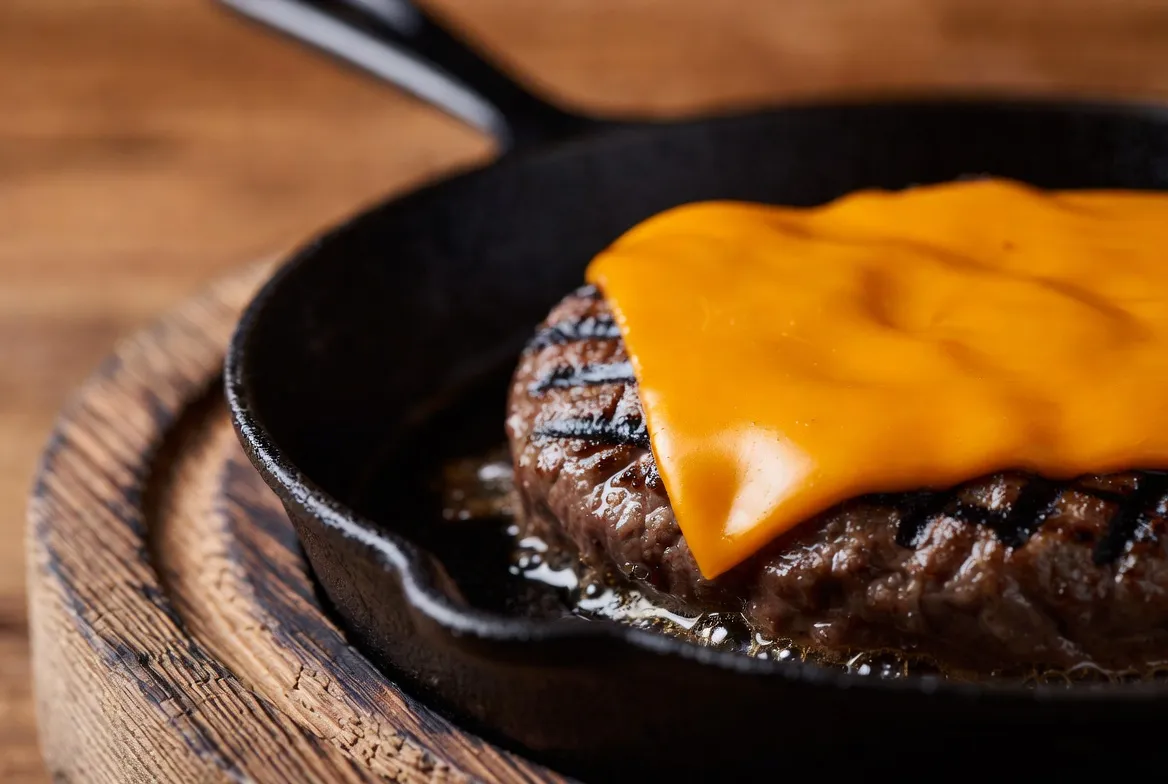
After 60–90 seconds, when the edges are dark and crispy, scrape the patty cleanly from the surface and flip once. Apply a slice of real cheddar and allow 30 seconds to melt.
Two important caveats: use a fine-mesh splatter guard, and never attempt this technique with a starchy pre-packaged patty — the synthetic binders will scorch and fuse to the pan rather than forming a crust.
For best results, use 20% fat mince from Waitrose, Sainsbury’s, or your local butcher. Aldi’s Ashfields Lean Beef Mince is excellent for a leaner smash.
A note on UK nutritional labels
UK and EU food labelling law requires that dietary fibre is already excluded from the carbohydrate total. The figure printed on a UK pack is already the net, digestible carbohydrate value. Applying the US convention of subtracting fibre again will cause you to significantly undercount your carbohydrate intake.
Carbohydrate figures in this guide come from manufacturer labels and third-party databases, checked March 2026. In July 2026, figures for products we could match to manufacturer data on Open Food Facts (including the M&S Our Best Ever, Morrisons The Best lines, and Hellmann’s) were re-verified and corrected where they differed. If you spot a discrepancy between this guide and the physical pack, the pack is always correct — manufacturers reformulate products without notice. Prices are deliberately not listed; check the retailer for current pricing. This content is for informational purposes only and does not constitute medical advice.